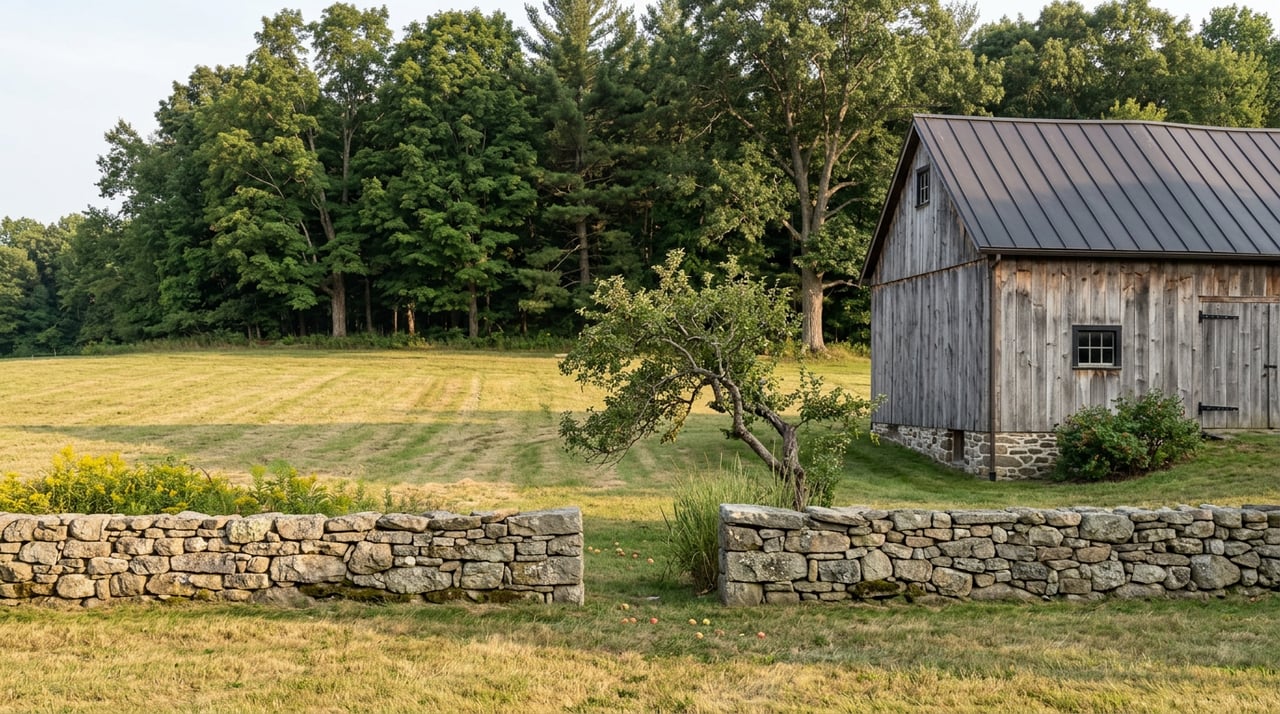
On June 29, 2023, seventy acres on Prospect Hill changed hands in a way no ordinary listing ever does. The land had grown apples and peaches for more than a century. The buyer was not a family looking for a country retreat. It was the Commonwealth of Massachusetts and the Town of Harvard, closing on an Agricultural Preservation Restriction that now binds the orchard to farming, permanently, no matter who owns it next.
If you own farmland, an orchard parcel, or a large historic homestead in Harvard, you have probably heard the term APR mentioned in passing, maybe at a town meeting, maybe by a neighbor, maybe by a title company during a refinance. Most owners assume it means their land is somehow off the market, locked away from a normal sale. That assumption is wrong, and the actual mechanics are more useful to understand than the myth.
The fear sellers have, and what actually happens
The instinct is understandable. A permanent deed restriction sounds like permission you no longer have. But an APR does not freeze ownership. The landowner keeps the property and can sell it at any time. What changes is who is allowed to buy it and at what price, because the restriction is recorded against the deed and travels with the land to every future owner.
The Prospect Hill Community Orchard makes this concrete. Community Harvest Project has owned and operated the orchard since 2014, a nonprofit that has donated more than 360,000 pounds of apples to food banks since 2015. Selling the APR did not force the nonprofit off the land. It let the organization convert the development value of seventy acres into an endowment for its mission, while the Town of Harvard, Sudbury Valley Trustees, and the Harvard Conservation Trust matched the state's contribution to make the deal work. The orchard now sits inside a connected corridor with Dean's Hill, Fruitlands, and the Oxbow National Wildlife Refuge, with views that run from Bare Hill Pond toward Mount Wachusett.
State Representative Danillo Sena, whose district includes Harvard, put the intent plainly:
"The APR funding keeps the character of our communities by preserving important farmland permanently."
That is the point of the program. It is not designed to trap owners. It is designed to make sure that once land is farmed, it stays farmed, and the state pays the owner for that promise up front.
What survives the sale, and what doesn't
The restriction reshapes value more than it reshapes ownership. Massachusetts calculates a payment to the landowner equal to the gap between the parcel's fair market value and its agricultural value, then records a permanent restriction that keeps the land in farming use. Here is what that means in practice for a future sale:
| Question | What actually happens |
|---|---|
| Can the land be sold again? | Yes, at any time, by the current owner |
| Who can buy it? | Someone who qualifies as a farmer under state rules |
| What price applies? | Agricultural value, not fair market value |
| Does the house and outbuildings count? | The restriction applies to the land use; structures are addressed in the specific APR document |
| Who enforces it? | MDAR monitors annually to confirm permitted and prohibited uses are upheld |
The number that surprises most sellers is the price ceiling. A parcel that would command a premium as a buildable homesite sells, under APR, at what the land is worth as farmland. That is the trade the original owner made in exchange for the state's payment. It is a permanent trade, not a temporary one.
The paperwork that actually decides your timeline
Here is where most of the anxiety around APR sales is misplaced. Since 1985, most Massachusetts APRs include either a Right of First Refusal or an Option to Purchase at Agricultural Value, which gives the state the legal ability to step in and buy the land itself when it comes up for sale. Owners assume this means state approval is required and slow. In practice, the opposite is closer to true.
When a landowner has a real offer, the APR document requires notifying the Massachusetts Department of Agricultural Resources of the intent to sell. The landowner can request that MDAR waive its purchase right at the same time. Over the program's four decade history, MDAR has chosen to waive that right in the vast majority of cases and has only transferred or exercised it four times total. The state does not want to own farmland. It wants farmland to stay in farming hands, and it has built an automatic path to get there without becoming the buyer itself.
That automatic waiver depends on the buyer qualifying, and this is the part sellers need to plan around. A buyer typically needs to show:
- At least two of the preceding five years spent farming
- A Farm Business Plan that MDAR reviews and finds viable for the specific parcel
- No history of violating an APR the Commonwealth already holds
A Beginning Farmer or a nonprofit organized to lease land to farmers can also qualify through a discretionary waiver, again backed by a reviewed business plan. The friction in an APR sale, in other words, is not a state veto. It is finding a buyer who can clear these qualifications and assembling the paperwork MDAR needs to sign off quickly rather than sit in a queue.
Why this matters beyond orchard country
Harvard's identity as a farming town did not happen by accident, and the numbers explain why so much of that land is now protected rather than subdivided. Massachusetts farmland runs roughly 3.4 times the national average price per acre, according to a report from the state legislature's Special Commission on Agriculture in the Commonwealth in the 21st Century, which means the pressure to sell for development has always been intense here. As of June 2025, MDAR had acquired 970 APRs protecting about 77,115 acres statewide, a program built specifically to counter that pressure one working farm at a time.
There is also a generational dimension worth naming plainly. A large share of Massachusetts farmers are past typical retirement age, which means the decision to sell, restrict, or pass down land is landing on more Harvard families now than it has in decades. An APR is one tool in that decision, alongside Chapter 61A tax classification and outright conservation donation, and each carries different consequences for what a future sale looks like.
None of this is a reason to avoid selling land that carries an APR, or to avoid placing a new restriction on land you want to see farmed permanently. It is a reason to understand the mechanism before you list, because the buyer pool, the appraisal standard, and the notification timeline are all different from a conventional sale, and a listing agent who does not know that will cost you months.
Frequently asked questions
How do I find out if my Harvard property has an APR? The restriction is recorded against the deed, so a title search or a call to the Massachusetts Department of Agricultural Resources will confirm whether a parcel is enrolled and what the specific document permits.
Does an APR reduce my property taxes? Land under an APR is assessed using the same methods as Chapter 61A agricultural land. It is not tax exempt, and property taxes are still owed, though typically at a lower agricultural assessment than a comparable unrestricted parcel would carry.
Can I still live in the farmhouse if the land has an APR? The restriction governs land use for agricultural viability. Specific provisions for existing structures, and any limits on new construction, are spelled out in the individual APR document, which is why reading the actual recorded restriction matters more than general assumptions about the program.
What happens if a prospective buyer doesn't qualify as a farmer? The sale can still proceed to a qualifying buyer, but a non-qualifying buyer will not clear the automatic waiver process, which means the state's purchase right stays active and the timeline extends while MDAR reviews the situation.
Selling protected farmland, an orchard, or a historic Harvard homestead is not a transaction you want to learn on the fly. Hilary Bovey has spent a career treating New England's historic properties as something to steward, not just move, and that includes the parcels where a permanent restriction is part of the story. Let's Connect.